
A poorly drafted testamentary trust can leave beneficiaries exposed to prohibitive land tax and purchase surcharges
A discretionary testamentary trust remains one of the most effective ways to protect and pass wealth across generations.
How it is drafted, however, can carry annual tax consequences long after the will is signed. A clear example is the NSW foreign surcharge regime as it applies to residential property held in a discretionary testamentary trust.
Unless the trust deed irrevocably excludes ‘foreign persons’ as potential beneficiaries (as that term is defined in the Foreign Acquisitions and Takeovers Act 1975 (Cth), as modified by s 5D of the Land Tax Act 1956 (NSW) and s 104JA of the Duties Act 1997 (NSW)), the trustee will be treated as a foreign person under the NSW surcharge regime.
This post explains how the surcharges reach testamentary trusts and the drafting options worth discussing with a specialist succession lawyer before you sign, or re-draft, your will.
The two surcharges
Surcharge purchase duty
Payable on acquisitions of NSW residential-related property on top of ordinary transfer duty. The rate is now 9% of dutiable value (was 8% until 31 December 2024).
Surcharge land tax
Payable every year on the assessed taxable value of NSW residential land owned at midnight on 31 December. The rate is now 5% of the taxable value from the 2025 land tax year (previously 2% from 2018, then 4%).
Surcharge land tax is far harsher than ordinary land tax. There is no tax-free threshold, so it applies from the first dollar. The principal place of residence exemption is limited to natural persons, so a discretionary trust cannot claim it even if a beneficiary lives in the home. And it recurs every year for as long as the land is held.
Example:
For a $10 million property, that means an additional $900,000 on acquisition and a further $500,000 each and every year.
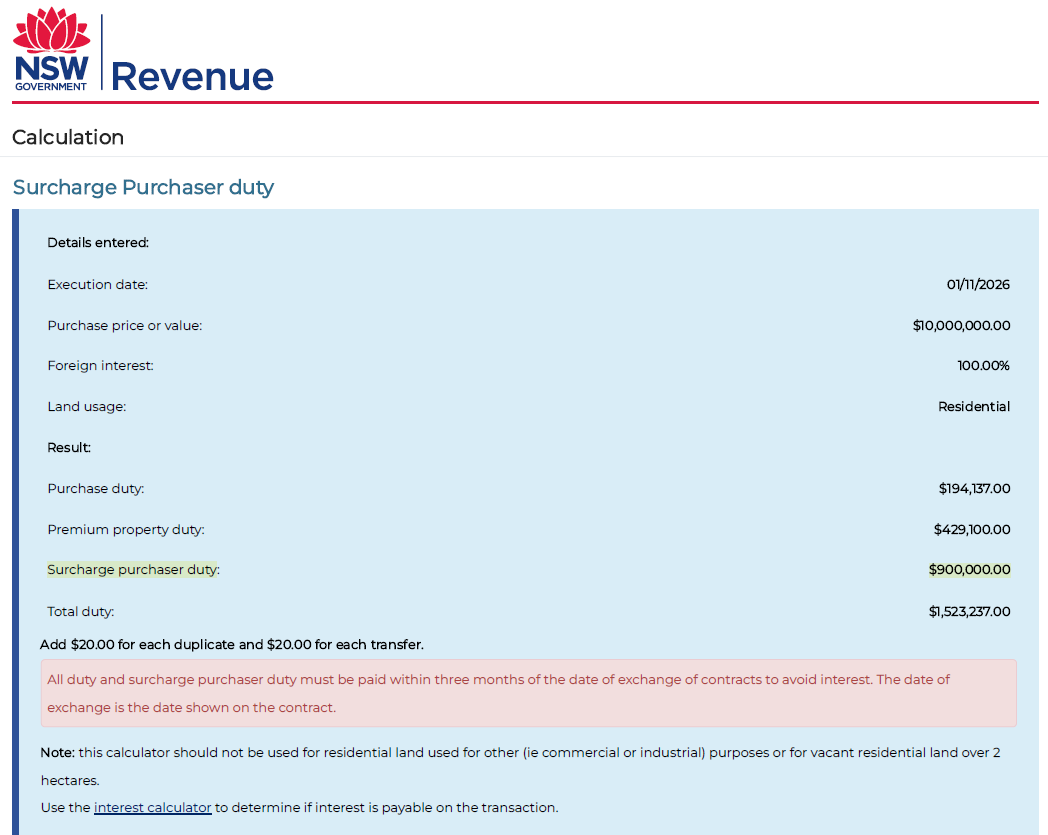
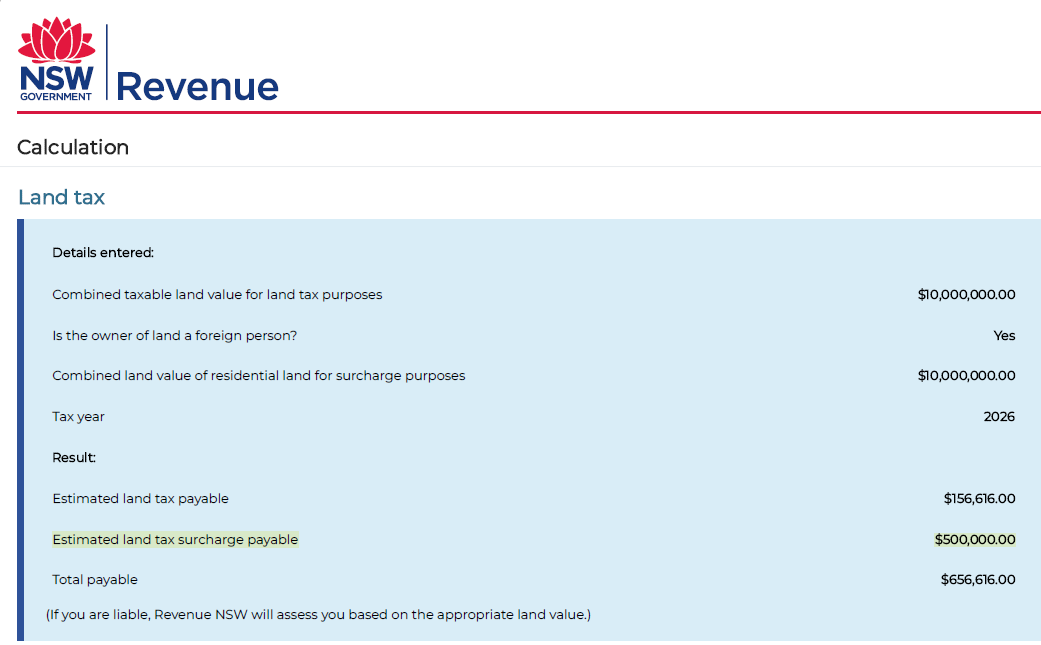
Foreign Investment Review Board (FIRB) approval adds a non-refundable application fee of $281,700 (new dwellings) or $845,100 (existing dwellings), noting the prohibition on trustees deemed to be ‘foreign persons’ acquiring established residential property under s 95 of the Foreign Acquisitions and Takeovers Act 1975 (Cth).
Why a testamentary trust can be a ‘foreign person’
Section 5D of the Land Tax Act 1956 (NSW) and section 104JA of the Duties Act 1997 (NSW) treat the trustee of a discretionary trust that owns NSW residential property as a foreign person unless both of the following requirements are met:
no potential beneficiary of the trust is a foreign person; and
the terms of the trust cannot be amended in a way that would make a foreign person a potential beneficiary.
Revenue NSW takes a deliberately broad view of this test in its practice note on discretionary trusts (CPN 004). Potential beneficiaries include every member of every class to whom trust property may be distributed or applied, each deemed to hold the maximum interest over which the trustee could exercise a discretion. A person is a potential beneficiary if exercising, or not exercising, a discretion could result in them benefiting.
The usual broad testamentary trust class (children, grandchildren and remoter issue, their spouses, and related companies and trusts) is therefore almost certain to catch someone, such as a non-citizen in-law, a grandchild raised overseas, or a permanent resident who fails the 200-day presence rule.
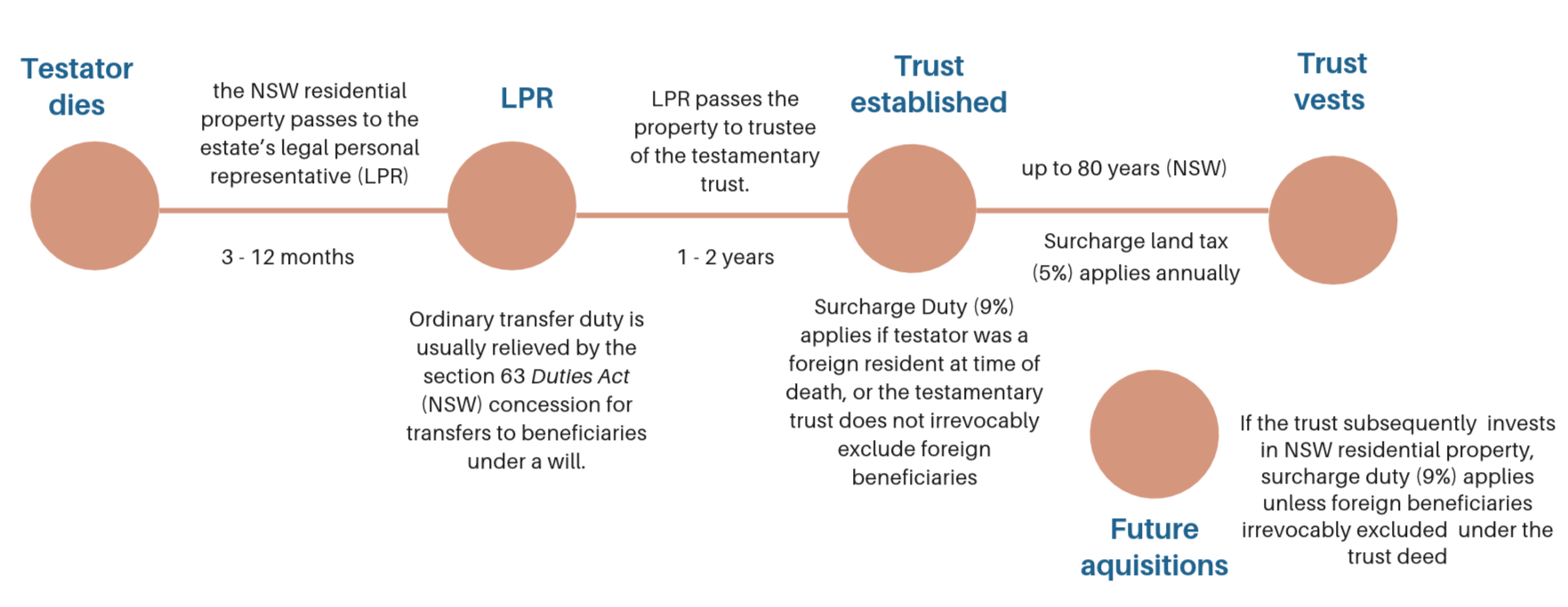
Following the property through the trust lifecycle
The drafting options
First, check the date of your will. If the will establishing the testamentary trusts was signed on or before 31 December 2020, the transitional exemption applies.
Otherwise, the central question is whether you are comfortable that your long-term vehicle for multigenerational wealth will permanently exclude foreign persons.
The answer usually leads to one of five approaches:
Option 1: Irrevocably exclude foreign persons from every testamentary trust
The simplest and most certain approach, suited to families with no foreseeable overseas connection. The cost is that a beneficiary who later becomes (or marries) a foreign person is permanently shut out.
Option 2: Add a special-purpose trust for NSW residential property
The residue passes to a conventional discretionary testamentary trust with the usual broad class, while a specific gift of NSW residential-related property goes to a separate trust that irrevocably excludes foreign persons.
This preserves flexibility for the rest of the estate, but requires more complex drafting and a precise definition of the gifted property.
This is typically the recommended approach where your would like the property to be retained by the family, rather than liquidated as an estate asset.
Option 3: Accept the surcharge
For some families, keeping foreign beneficiaries eligible is worth more than the surcharge. This should be a deliberate, documented decision made with an understanding of the 5% annual and 9% acquisition rates.
Option 4: Draft conventionally with a power to exclude foreign persons after death
This defers the decision until family circumstances are known, but Revenue NSW applies tracing provisions (NSW Revenue Ruling G 009 definition of a ‘foreign person’), the exercise must fit within the two-year land tax window after death, and the power is irreversible.
It is a fallback, not a plan.
Option 5: Direct any NSW residential property owned at death into a dedicated trust that excludes foreign persons
This adapts Option 2 for clients (including interstate clients) whose NSW holdings may change before death, much like the separate superannuation proceeds testamentary trust we (Eastern Hill) already use.
Similar to Option 2, the is typically the approach we recommend
Drafting traps in recent decsions
Temporal limits can defeat an exclusion
In N & G Grima Family Trust Pty Ltd v Chief Commissioner of State Revenue [2025] NSWCATAD 149, the NSW Civil and Administrative Tribunal confirmed a surcharge land tax assessment against a discretionary family trust because its foreign person exclusion clause contained a temporal limitation (the trust deed excluded ‘foreign persons’ from being beneficiaries, but only while the trust held real property), failing NSW’s strict irrevocable "no amendment" requirements.
The exemption protects the trustee, not entities below it
In Hixson Pty Ltd v Chief Commissioner of State Revenue [2025] NSWSC 192, residential development land was owned by the plaintiff that was a subsidiary of a company held beneath an exempt testamentary trust (the Lady Fairfax Testamentary Trust) was still assessed as a foreign person, establishing that a concession attaching to the trustee of an Australian testamentary trust does not necessarily flow through to a subsidiary company that acquires or owns the residential property.
Limited timeframe to amend the trust deed
In Fujun Pty Ltd ATF Ni Family Trust v Chief Commissioner of State Revenue [2022] NSWCATAD 412 the plaintiff had amended to trust deed to irrevocably exclude foreign persons as beneficiaries, however the tribunal held that the trustee remained a foreign person because the deed had not been amended by the statutory deadline to prevent foreign persons from being beneficiaries.
Why specialist advice matters
None of this is a reason to avoid a testamentary trust, but it does highlight why it needs to be drafted (or reviewed) by a specialist succession lawyer (like Eastern Hill) who can:
confirm the date of your existing will and codicils, and whether a new document would forfeit the transitional exemption;
map your family’s current and likely overseas connections in the context of the ‘foreign person’ statutory definitions;
help you select between Options 1 to 5 and draft your will and trust deed to reflect your intentions;
draft exclusion clauses that are unconditional and irrevocable, with no time limits or provisions that could revive foreign beneficiaries; and
consider the whole structure, including companies and trusts the testamentary trust may control, and whether an interstate client’s trust might ever own NSW residential land.
Disclaimer
This post is general information only and is not legal or tax advice. The surcharge rules, rates and Revenue NSW rulings change regularly. Advice should be obtained on the facts of each estate before a will is signed or varied